The 30 minute money date agenda for couples
A 30 minute money date agenda in four timed blocks, what each of you brings to it, and what to change in your first month and in a month that went wrong.
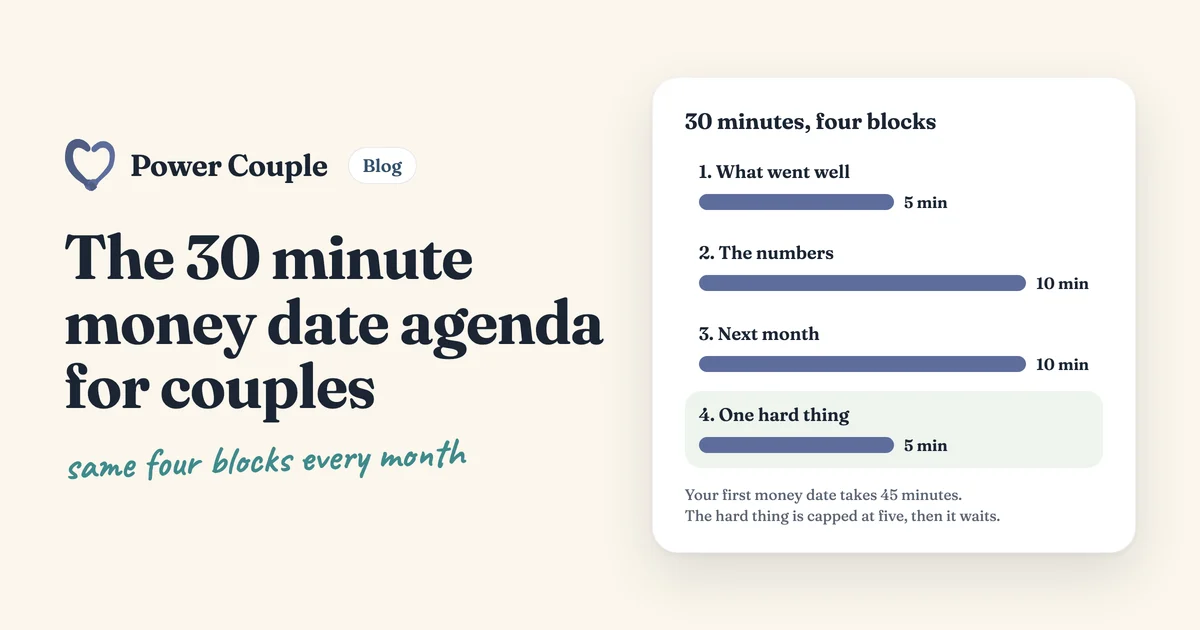
A money date is a short meeting about your money that happens on the same day every month, and 30 minutes is enough for it. Split those 30 minutes into four blocks. Five minutes on what went well, ten on the numbers, ten on what's coming next month, five on the one hard thing you've both been avoiding. The agenda below is the one I'd hand a couple starting this week, with what each of you brings to it and what changes in a month that went badly.
Key takeaways
- Four blocks, 30 minutes. What went well (5), the numbers (10), next month (10), one hard thing (5).
- The two easy blocks go first on purpose. In a six year study of newlyweds, the first three minutes of a difficult conversation predicted whether the marriage lasted.
- Bring the month's figures already added up. A money date is not the night you do the adding up.
- One hard thing per month, capped at five minutes. If it isn't settled, it goes back on the list and waits.
- Your first money date takes about 45 minutes, because the numbers block becomes "what do we actually earn and owe".
- Monthly is the standard advice. Mexico's CONDUSEF says to review a couple's budget at least once a month or whenever income or responsibilities change.
What a money date is, and why the agenda matters
The idea is well travelled. Fidelity's first tip to couples is to make it a money date and "set aside time, maybe once a month" (Fidelity, 19 May 2026). The University of Utah's Financial Wellness Center teaches money dates one to two times a month, and says the couples it counsels who hold them have more success reaching their goals (University of Utah, 27 October 2023). That's the centre's read on the couples it sees rather than a measured result, and it still matches what the surveys show about couples who don't talk.
What almost nobody gives you is the clock. Set aside time, talk about money, be positive, and good luck. So the first money date runs two hours, ends in the argument you were both circling, and there isn't a second one. The blocks and the minutes are the whole point.
Fidelity surveyed 3,193 married or partnered adults in the United States. Fewer than a third regularly talk about day to day money or longer term decisions, and 49% avoid money conversations to prevent arguments (Fidelity, 2026 Couples & Money study, fielded October to November 2025). Half said they wish they talked about day to day money more. People aren't refusing the conversation. They're refusing one that has no shape and no end.
The 30 minute agenda
Same four blocks, same order, every month.
| Block | Minutes | What happens |
|---|---|---|
| 1. What went well | 5 | Each of you names one thing that went right with money since last time. Nothing gets decided |
| 2. The numbers | 10 | What came in, what went out, what's left, where each goal stands. Read them out, don't argue with them |
| 3. Next month | 10 | Anything that makes next month not a normal month. A trip, a birthday, a bill that lands twice a year, a payday that moves |
| 4. One hard thing | 5 | The single item off your running list. Five minutes, then it's settled or it waits |
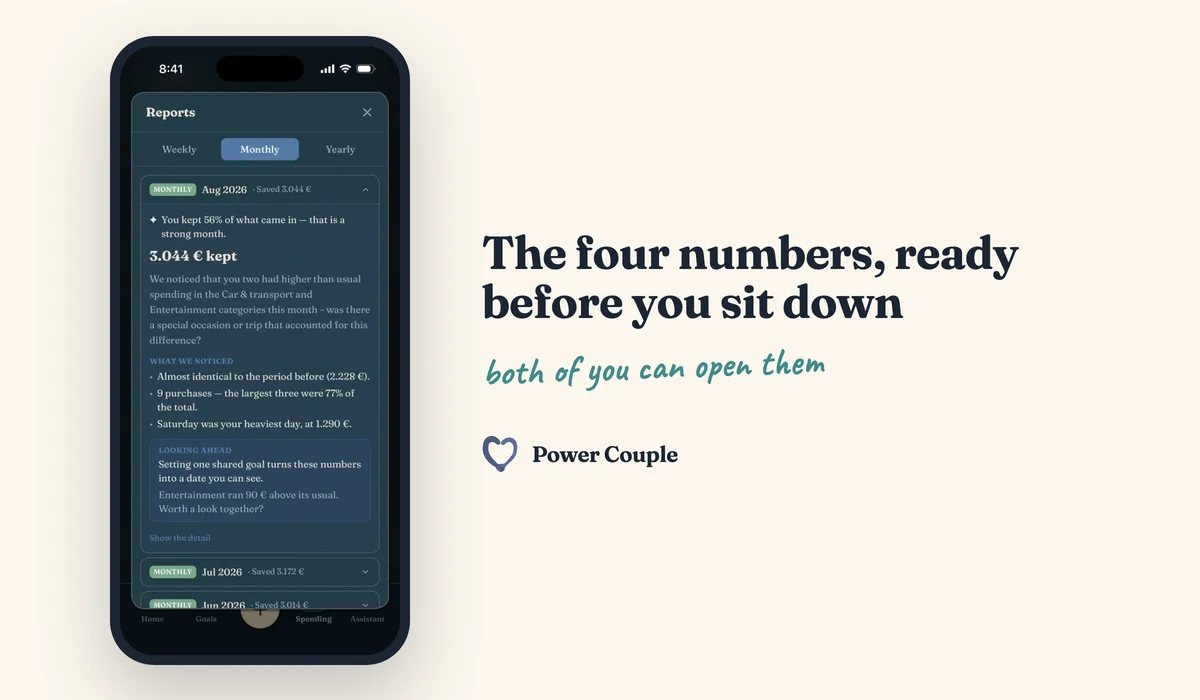
Four numbers from block 2 are enough. Money in, money out, what's left, and how far along the goal you both care about is. For a couple on $4,200 a month that reads as money in $4,200, money out $3,650, left $550, and the house deposit at $3,400 of $10,000. Thirty seconds to say, and you're both now looking at the same month.
Block 4 is the one couples get wrong, and the cap is what makes it work. One item, five minutes, and if you haven't landed it you write it back on the list and go and do something else. A decision you can't reach in five minutes usually needs a number neither of you has yet, which makes it next month's item rather than tonight's argument.
Why the easy blocks come first
Because of how the opening minutes set everything that follows. University of Washington researchers tracked newlyweds for six years and found they could predict which couples would divorce from the first three minutes of a discussion about a continuing disagreement. Couples who later divorced opened those talks with more negative words and gestures and fewer positive ones. As John Gottman put it, the way a couple begins a discussion about a problem "is absolutely critical" (University of Washington, 27 September 1999).
So the five minutes on what went well isn't a warm up you can skip to save time. It's the only part of the agenda that decides what the next 25 minutes sound like. Profeco, Mexico's consumer protection agency, gives couples the same instruction from the other end, telling them to celebrate the wins such as clearing a debt or reaching a savings goal (Excélsior, 9 February 2026, in Spanish).
What each of you brings
Three things, and all three are ready before you sit down:
- The month's figures, already added up. If the meeting starts with one of you opening a banking app and scrolling, you've spent your ten minutes on data entry and the other person is on their phone.
- Your own list of what's coming. Each of you writes it separately, because you each know things the other doesn't.
- The running list of hard things. It lives somewhere you both walk past. Ours would go on the fridge.
In one of our conversations, my fiancée and I were talking about what marriage will look like for us, and what we each used to buy for ourselves before. After a while we realized, or at least I did, that the things my fiancée used to buy won't be feasible at the beginning of our relationship. So I asked her what one item out of those she could accept leaving behind. She thought it over carefully, we chose one, and we found an alternative that gave basically the same result for less money.
That attitude matters when you compromise. Don't ask for too much at once. It worked for us. It took her some time to fully accept it, but I feel more assured about realistic expectations now, and she'll do her part too, making sacrifices and adjusting her expectations. We had no conflicts, just a calm, thought-out conversation.
Where the numbers come from
Any method that gets you four numbers in advance is fine. A spreadsheet works. A notebook works.
What tends not to work is a budget only one of you can see, because then block 2 is one partner reporting to the other, and the other has no way to check or add anything. Fidelity found that 68% of couples didn't know their partner's full financial picture before they moved in together. A money date is how that gap closes, and it only closes if both of you can open the same numbers.
That's what I built Power Couple for. One shared budget both partners can open, entries added from a photo of a receipt, a bank statement file, typing or voice, and a Money Date screen that holds the figures block 2 needs. It's free, and everything is encrypted on the phone, so the numbers stay between the two of you. Safe to spend is the one it puts at the top, meaning what's left for the rest of the month once bills, goals and both personal allowances are set aside.
Your first money date is longer
Plan 45 minutes for the first one and swap block 2 for the bigger question, which is what you actually earn and owe between you. That's 25 minutes rather than ten. Every income, every recurring bill, every debt with its interest rate, every account. Profeco suggests each partner does their own check first and then brings it, which is a good way to keep the first meeting from turning into a discovery session.
Write down what you find, because next month's ten minute version reads off that list. You only do the long one once.
A month that went wrong
Some months the numbers are bad. Spending ran over, a goal went backwards, something broke.
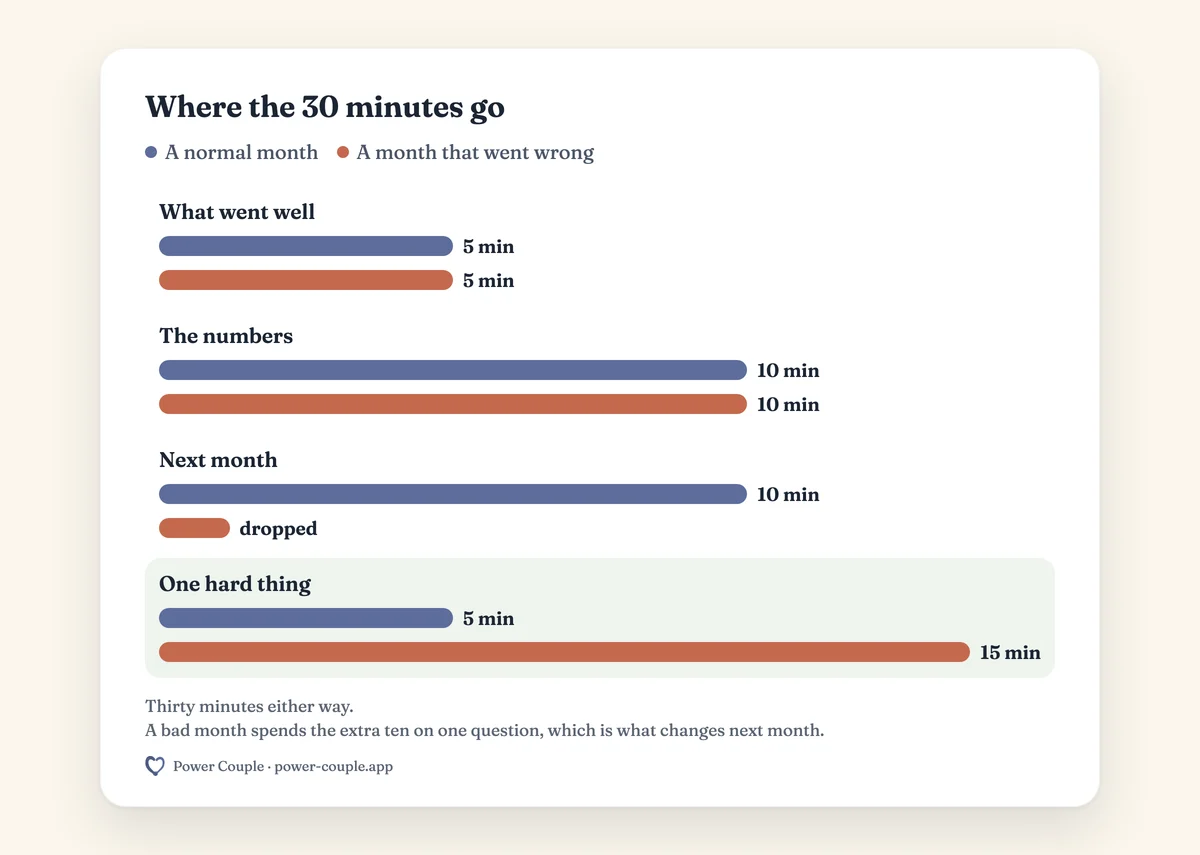
Keep blocks 1 and 2, drop block 3, and give those ten minutes to block 4, which gets 15 minutes instead of five. One question fills them. What do we change next month? Not who did it, not what it says about either of you. What changes.
Block 1 matters most in exactly these months, and it's the one you'll want to skip. Find the thing that went right anyway, even if it's small.
My view on whose money this is
A money date works differently depending on whose money is on the table, so here's where I stand. If you've committed to each other for life, I recommend one shared pot. All income goes in and there's no "mine" and "yours". A personal allowance is the part of the shared pot each of you spends without explaining, and it's the same amount for both of you. Splitting costs by a formula is for roommates.
There's evidence behind this. A randomised experiment followed 230 engaged and newly married couples who held separate accounts, assigning some of them to merge their money. Over two years, the couples who merged held their relationship quality steady where the others declined (Olson and colleagues, Journal of Consumer Research, 2023).
It also makes block 2 much shorter. With one pot there are four numbers. With split accounts there are two sets of four, plus the question of who owes whom, and the whole meeting bends toward settling up. CONDUSEF's advice sits alongside this well, recommending that each partner keep a personal fund of their own even when the rest is shared (CONDUSEF, Revista Proteja su Dinero, 1 February 2026, in Spanish).
One exception I'd never leave out. Where one partner uses money to control the other, keep access to an account in your own name and get help. Pooling assumes trust, and a money date can't manufacture it.
This is general information about handling money together and not personal financial advice.
How this post was put together
I checked every source linked above on 30 October 2026. Each one is read for what it actually says rather than what other pages say it says, and dated, so you can see how old the number is. Our editorial rules are on the about page. If you find something wrong here, contact me and I'll fix it.
Questions people ask
How long should a money date be?
Thirty minutes once you're in the rhythm, 45 for the first one. If yours regularly runs past an hour, the figures weren't ready before you sat down, or you're trying to settle more than one hard thing in a sitting.
How often should we hold one?
Once a month suits most couples, on a fixed day. CONDUSEF says a couple's budget should be reviewed at least once a month or whenever income or responsibilities change, and the University of Utah's financial counsellors teach one to two times a month. Twice a month is worth it when money is tight or something big is in flight, such as moving house.
What if we argue every time?
Shorten block 4 rather than dropping it. Two minutes, one item, and then stop whether or not it's resolved. Most money arguments are about the same two or three unresolved things, and those need a decision each, not a longer meeting. If money talk reliably turns into a fight about something else, that's worth taking to a counsellor rather than solving with a better agenda.
What if one of us handles all the money?
Then block 2 is where that changes. The person who handles it reads the four numbers out loud, and the other person's job is to ask one question about them. Not to take over, just to know. After three or four months the numbers stop being one person's department.
Does a money date need an app?
No. It needs four numbers both of you can see before you sit down, and a list of what's coming. A shared app saves the adding up and makes sure you're both looking at the same figures, which is the part that goes wrong with a spreadsheet only one of you opens.