How to split finances as a couple: 5 ways, and the one I recommend
Five ways couples handle money, from 50/50 to one shared pot, worked through with numbers, and why I recommend pooling it all once you commit for life.
Most couples handle money in one of five ways. They split shared costs 50/50, split them in proportion to income, divide the bills, keep "yours, mine and ours", or put everything into one shared pot. If you've committed to each other for life, I recommend the last one. All income goes into one pot, there's no "his" or "her" money, and you each get the same personal allowance, whoever earns more. The other four work fine for roommates. In a marriage, they keep a running tab of who paid for what. Below, one couple goes through all five so you can see the difference in numbers.
Key Takeaways
- For a couple committed for life, I recommend one shared pot. All income in, no "his" or "her" money, and the same personal allowance for each of you.
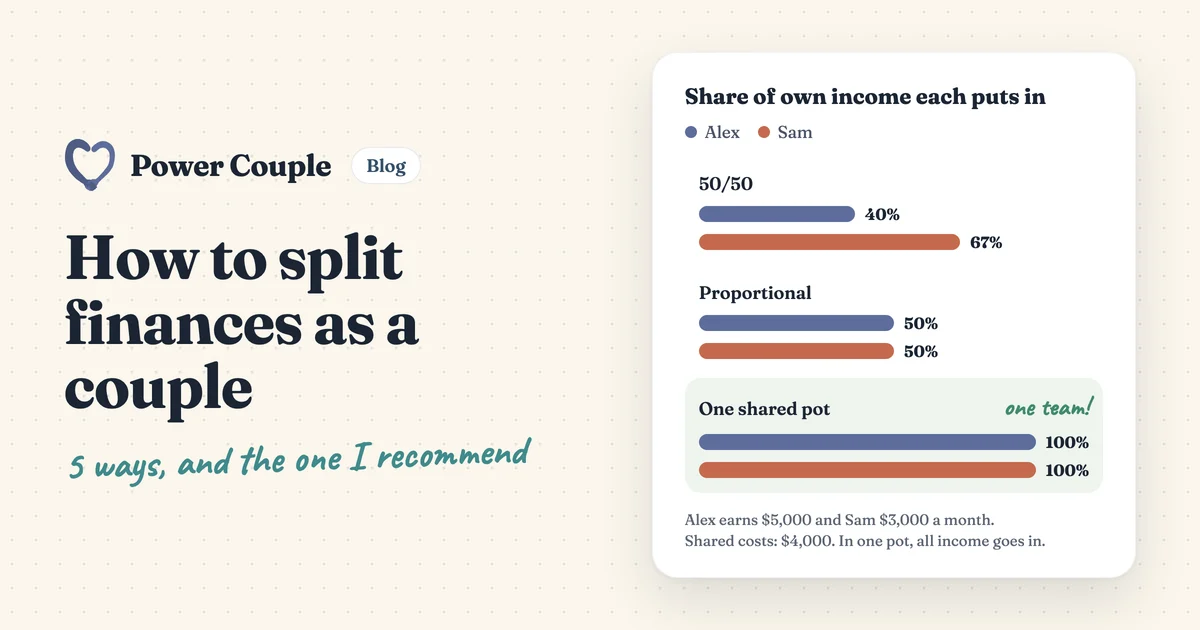
- Every split leaves two piles of money. With uneven incomes, 50/50 makes the lower earner pay a far bigger share of what they earn, 67% against 40% in the example below.
- Merge because you've committed to each other. Your incomes don't need to match, and a big gap is where one pot helps most.
- In a 2023 experiment, newlyweds who were asked to merge their money kept their relationship quality over two years, while the other couples saw the usual decline.
What are the ways to split finances as a couple?
From the most separate to the most shared:
- 50/50. Add up the shared costs and each of you pays half. Everything else stays separate.
- Proportional. You each put the same percentage of your income toward shared costs, so whoever earns more pays more dollars.
- Split the bills. One of you takes the rent, the other takes groceries and utilities, or some other division.
- Yours, mine and ours is a joint pot for the shared costs that you both pay into. The rest of your income stays apart.
- One shared pot. Both incomes go in, and everything comes out of it. The shared costs, savings for your goals, and the same personal allowance for each of you. It's the one I recommend once you've committed to each other for life.
One couple, five setups, in numbers
Take Alex and Sam. Alex's monthly income is $5,000 and Sam's is $3,000. Their shared costs come to $4,000 a month:
| Shared cost | Per month |
|---|---|
| Rent | $2,200 |
| Groceries | $1,000 |
| Utilities | $400 |
| Insurance and phones | $400 |
| Total | $4,000 |
Run those through the five setups:
| Model | Alex puts in | Sam puts in | What is left over | Whose is it? |
|---|---|---|---|---|
| 50/50 | $2,000 | $2,000 | Alex $3,000, Sam $1,000 | Each partner's own |
| Proportional (62.5% and 37.5%) | $2,500 | $1,500 | Alex $2,500, Sam $1,500 | Each partner's own |
| Split the bills (Alex rent, Sam the rest) | $2,200 | $1,800 | Alex $2,800, Sam $1,200 | Each partner's own |
| Yours, mine and ours (proportional into a joint pot) | $2,500 | $1,500 | Alex $2,500, Sam $1,500 | Each partner's own |
| One shared pot | all $5,000 | all $3,000 | $1,600 for shared goals and a $1,200 personal allowance each | Both of theirs |
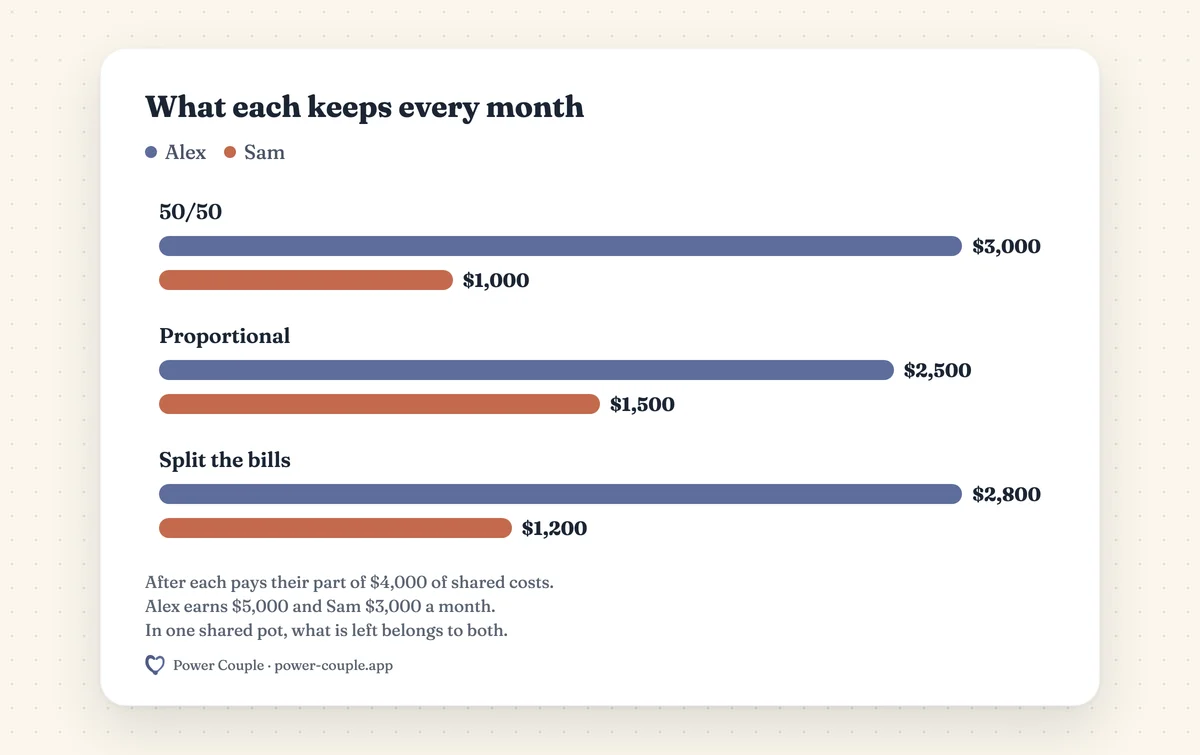
In the first four setups, part of the money always stays "mine". Under 50/50, Sam puts 67% of their income into shared costs and Alex only 40%.
A proportional split fixes the effort. Each partner's share is their income divided by your combined income (5,000 ÷ 8,000 = 62.5% for Alex). You still end up with two piles of money and a formula between them.
Splitting the bills drifts. Rent stays the same and groceries don't, so the split slowly moves away from what you agreed. "Yours, mine and ours" shares the costs and keeps most of the income apart, so the question of whose money pays for what never quite goes away.
One shared pot ends that question. There's nothing to calculate; it asks for openness instead. You both see every number and decide together what comes out of the pot, including a personal allowance each of you spends without explaining. Mexico's financial consumer agency, CONDUSEF, recommends one for each partner. It heads off resentment and the feeling of being controlled (CONDUSEF, "Amor que sí cuenta", Feb 2026).
Why I recommend one shared pot
My partner and I are preparing to get married, and I've noticed we sometimes disagree on money decisions. Here's what I believe. Once two people commit to each other for life, there's no "his" or "her" money, only "ours". Splitting costs by a formula keeps a quiet ledger running inside the relationship. Who earned what, who paid what, who owes whom. One pot swaps that ledger for a plan you make together, as a team working toward the same goals. It does ask for trust, that neither of you will use the shared money against the other.
So similar incomes are the wrong test. A big income gap is exactly where splitting hurts most and where one pot helps most.
I always thought that if my partner wanted to buy something I could clearly see was unnecessary, or that at least sounded unnecessary to me, just saying "I think that's too much" would sound like a biased opinion on my part. But if I can show something tangible and flip it into something positive, I can create an environment where it doesn't feel like a restriction, but more like hard work for one unified goal.
That's why I decided to create the "Calculate forecast" function in Power Couple. With it, we can select certain items and see how much closer we would get to our unified goal if we left that regular expense behind. Then she can also consider whether she wants the house one year sooner, or to buy clothes every month. This way, it's her journey now too, not just mine.
Which setup fits your situation?
| Your situation | What I recommend | Why |
|---|---|---|
| Married, or engaged and committed for life | One shared pot, with the same personal allowance each | You're building one life, and the money follows. |
| Committed for life, with a big income gap | One shared pot | The gap is where splitting hurts most. In one pot it stops mattering. |
| Committed for life, with similar incomes | One shared pot | You merge because of the commitment, and you have that. |
| Living together, not committed yet | 50/50 or proportional for the shared costs | You share a home, not yet a life plan. |
| Roommates or friends | 50/50, or by who uses what | It's a flatshare, not a household. |
| One of you brings debt into the marriage | One shared pot, with the debt in the shared plan | Decide together how the pot pays it off, and hide nothing. |
| One of you earns little or nothing for a while (studies, a career break, parental leave) | One shared pot | Nobody should have to ask permission to buy a coffee. |
One shared pot runs on trust. If one partner uses money to control the other, the person on the receiving end should keep an account in their own name and get help.
What the research says about joint and separate money
American couples keep more money apart than they used to. The US Census Bureau found that the share of married couples holding every account jointly fell from 53% in 1996 to 40% in 2023, and the share with no joint account at all rose from 15% to 23% (US Census Bureau, Sep 2025). The bureau suggests one reason. People marry later, with their finances already set up. Longer marriages share more, 79% of couples married 9 to 13 years had a joint account, against 68% of those married 4 to 8 years. Among unmarried couples living together, only 16% had one.
The strongest evidence for merging comes from an experiment. In a study published in the Journal of Consumer Research in 2023, researchers randomly assigned 230 engaged or newly married US couples to merge their money into a joint account, keep it separate, or choose for themselves. Over two years, the couples asked to merge kept their relationship quality, while the other groups showed the usual decline (Kellogg Insight, May 2023; the paper, DOI 10.1093/jcr/ucad020). The researchers' explanation is that shared money makes partners think as a "we" and stop keeping score. Partly merging, with a joint account next to separate ones, wasn't associated with the same benefit. That matches what I believe. Half a pot still keeps score.
How to set up one shared pot in one conversation
Give it about an hour. Before you sit down together, each of you should look at your own situation. Monthly income, debts, fixed costs and personal goals. Mexico's consumer agency, Profeco, suggests the same first step (Profeco press release, 14 Feb 2026, in Spanish). Then:
- Agree that it's one pot from now on. Both monthly incomes count as the household's, whoever earns more.
- Put every number on the table. Both incomes, any debts, and what each of you already pays for.
- List your shared costs and what you're saving for together.
- Set the same personal allowance for each of you, and an amount above which you talk first.
- Decide where the money sits. One joint account, or separate accounts you both treat as one pot.
- Look at the month together. A short Money Date every month keeps the pot clear and the trust intact.
Deciding is the easy part. Keeping both of you on the same numbers month after month is harder. Power Couple is built for one shared pot. One shared, encrypted budget for both incomes, with no split ratios, a personal allowance for each partner, and no bank login.

Frequently asked questions
Is splitting everything 50/50 fair?
Between roommates, yes. In a couple committed for life, I wouldn't split at all. When incomes differ, 50/50 asks the lower earner to give a much bigger share of their income, 67% for Sam against 40% for Alex in the example above. A proportional split evens that out; one shared pot makes the question go away.
What if one of us earns much more?
Then one pot matters even more. When you split, the income gap shows up every month as two very different piles of money. In one pot it's simply the household's income, and you decide together what it pays for.
Should we merge our money before we're married?
My line is a lifelong commitment, not the wedding date. Most unmarried couples don't share an account. Only 16% of unmarried US couples living together had a joint account in 2023, according to the Census Bureau.
What if one of us has debt?
Put it in the shared plan and decide together how much of the pot goes to paying it off each month. A debt you both know about is just part of the plan. A hidden one breaks trust.
How often should we review it?
Look at the month together every month, and redo the plan when something big changes. A new job, a raise, a move, a baby, or a stretch without income.