How to budget for Christmas as a couple, without January debt
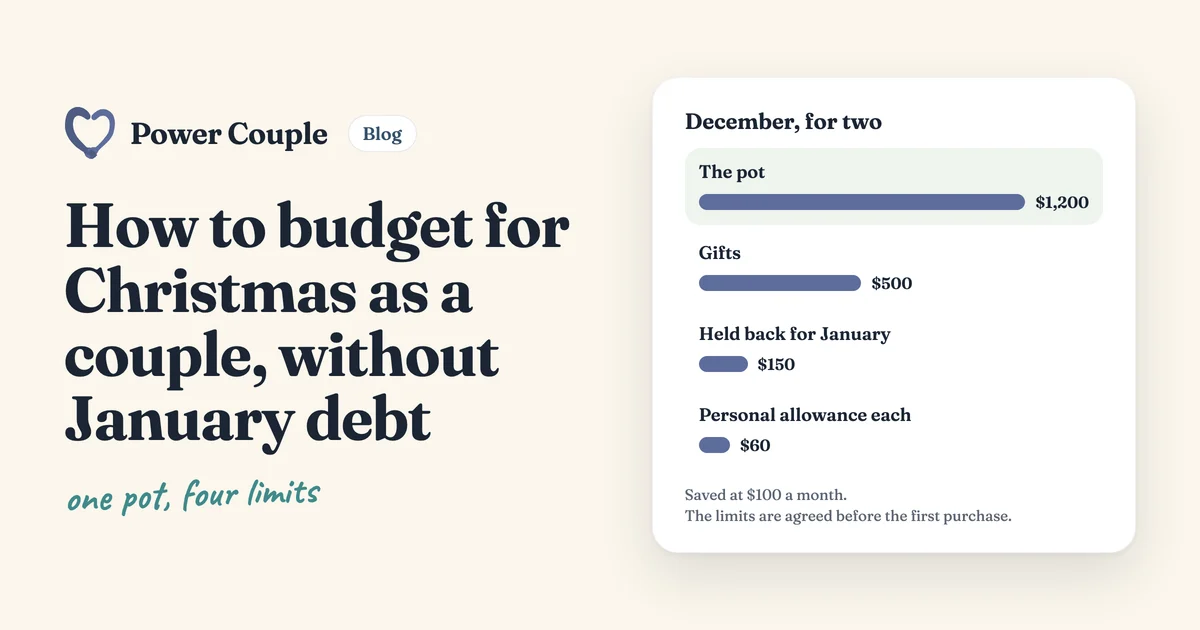
A December plan for two. One shared pot, four limits agreed before the first purchase, an equal personal allowance each and money held back for January.
My partner and I are preparing to get married, and we sometimes disagree about money. Christmas puts that to the test, because gifts, food, travel and hosting all land in the same few weeks, and two people rarely picture the same total. Christmas is one month with one total, not two shopping budgets that happen to overlap. Put the money in one pot, set four limits before the first purchase (gifts, food, travel and decorations), keep an equal personal allowance for each of you, and hold something back for January. That order is what decides whether you reach the second week of January with a clean card. The whole plan is below, with example figures that add up.
Key takeaways
- Agree the total and the four limits before the first purchase, not after the first shopping trip.
- A couple saving $100 a month reaches December with $1,200 to spend, and the plan fits inside it.
- Hold back January money first. In the example it's $150, and it's the line you'll be tempted to raid on 23 December.
- The personal allowance comes out of the shared pot, the same amount for each of you, spent without explaining. Your gifts to each other come from there.
- Gallup's last published reading had Americans estimating $1,007 each on gifts, so two people guessing separately are planning to spend around $2,000.
- When the limit runs out before the list does, cut the list. Don't reach for the card.
Start with one total, not two
Almost every holiday budget guide is written for one person, and the ones written for couples stop at "make each of you responsible for your own family". That's where December goes wrong, because two separate limits can't be exceeded together. Each of you stays inside your own number and the household still ends up over.
Gallup's most recent published measurement, from a poll taken 1 to 16 October 2025, found Americans expecting to spend an average of $1,007 on gifts that season, close to the $1,014 they predicted a year earlier (Gallup, 28 October 2025). That figure is per person. Two people each carrying their own version of it are quietly planning a $2,000 Christmas without either of them ever saying the number out loud.
Say the number out loud. One pot, one total, four limits.
Where the money comes from
A couple putting aside $100 a month reaches December with $1,200. That's the pot, and nothing goes on a card that isn't already in it.
The CFPB's holiday spending guidance starts in the same place, telling people to account for all of their typical expenses first so they don't come up short on bills or rent, and only then work out what's left for gifts. It also tells you to carry only the amount you plan to spend, and to have a specific plan for paying the card bill if you use one (CFPB, archived guidance, page last modified 25 June 2026). That page is in the CFPB's archive rather than its live advice, and the steps still hold.
If December is already here and nothing was set aside, the pot is whatever you can take out of this month's income without missing a bill. Smaller, same plan.
The December plan, step by step
Sit down once, half an hour, before anything is bought.
- Agree the total. What's saved, plus anything from December's income you can spare without missing a payment.
- Hold back January first. Insurance, a renewal, the quarter's bills, the trip home. Whatever lands in January is decided in December or it isn't decided.
- Set the four limits. Gifts, food and hosting, travel, decorations and extras. One number each, said out loud.
- Take out the personal allowance. The same amount for both of you.
- Write the gift list with a cap per person. The list comes after the limit, never before it.
Here's how that reads on a $1,200 pot.
| Line | Amount |
|---|---|
| Held back for January | $150 |
| Gifts | $500 |
| Food and hosting | $280 |
| Travel | $100 |
| Decorations and extras | $50 |
| Personal allowance, $60 each | $120 |
| Total | $1,200 |
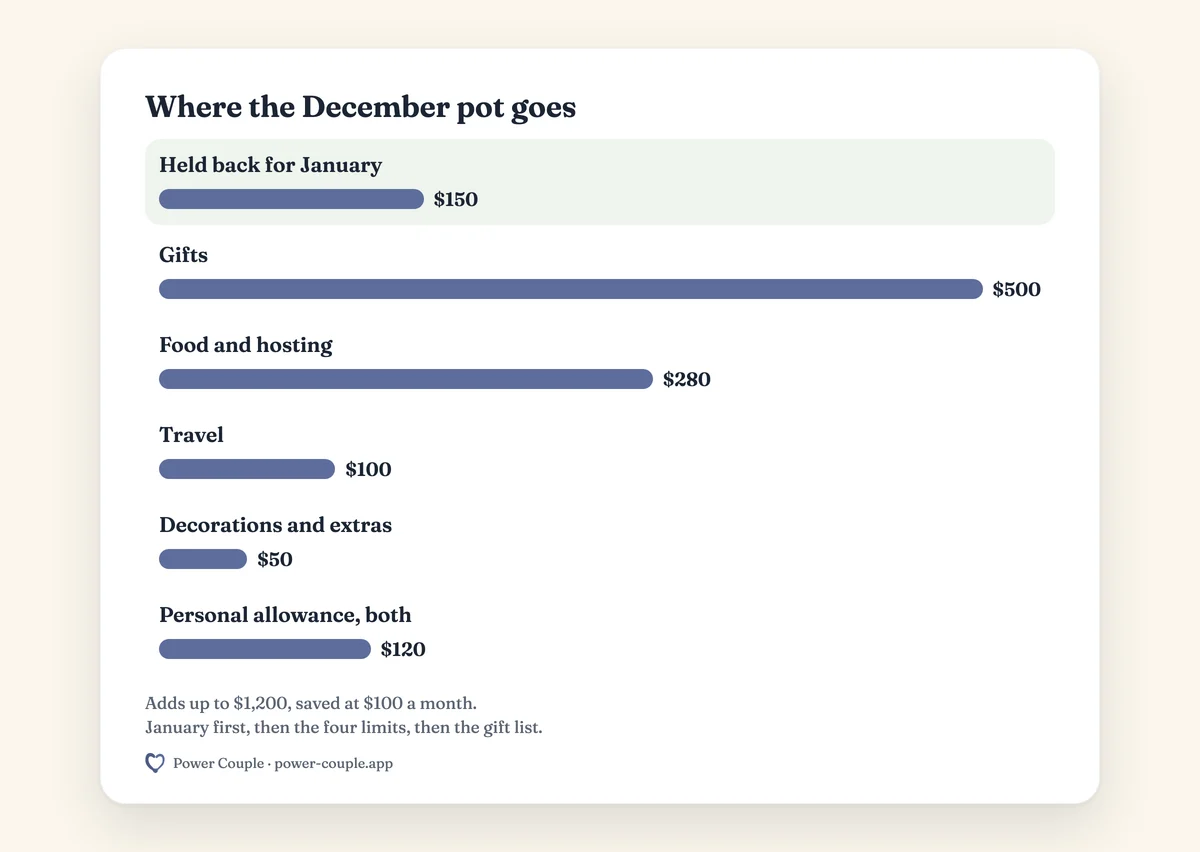
The amounts are an example. What doesn't change is the order. January first, then the four limits, then the list.
Who buys for whose family
The common advice is that each of you covers your own side. It reads as fair and it reintroduces the problem you just solved, because now there are two gift budgets again and one of you has a bigger family.
Keep the one gift limit and split the work instead. You each know your own side's names, sizes and tastes, so each of you writes and buys their own list, out of the same $500, with the same cap per person. Whose family is larger stops being a budget argument and becomes a shopping logistics question, which it always was.
The personal allowance, and your gifts to each other
A personal allowance is the part of the shared pot each of you spends without explaining. Same amount for both, agreed together. It's $60 each in the example.
Your gifts to each other come out of it, which is what makes the whole thing work. A surprise stops being a budgeting problem, because the money was set aside and agreed in advance. All that's left is keeping the purchase off the other person's screen until the day.
When the limit runs out before the list does
It usually does, and the answer gets decided now rather than in the checkout queue. Three moves, in this order.
- Cut the list. Cousins, colleagues, the office exchange. A message sent in good time saves both the gift and the awkwardness.
- Lower the cap per person evenly, from $40 to $28 for everyone, rather than dropping one person off the list.
- Move money between lines, with the other person there. Fifty dollars off decorations and onto gifts is a decision you both make, not an adjustment one of you makes.
The January line is the one you don't touch. It exists precisely because it's the first thing anyone wants to borrow from on 23 December.
Where the numbers come from
Any method works as long as both of you can see the same number on the same day. A notebook works. A spreadsheet works.
What tends not to work is a budget only one of you can open, because then December becomes one partner reporting to the other and the other has no way to check anything.
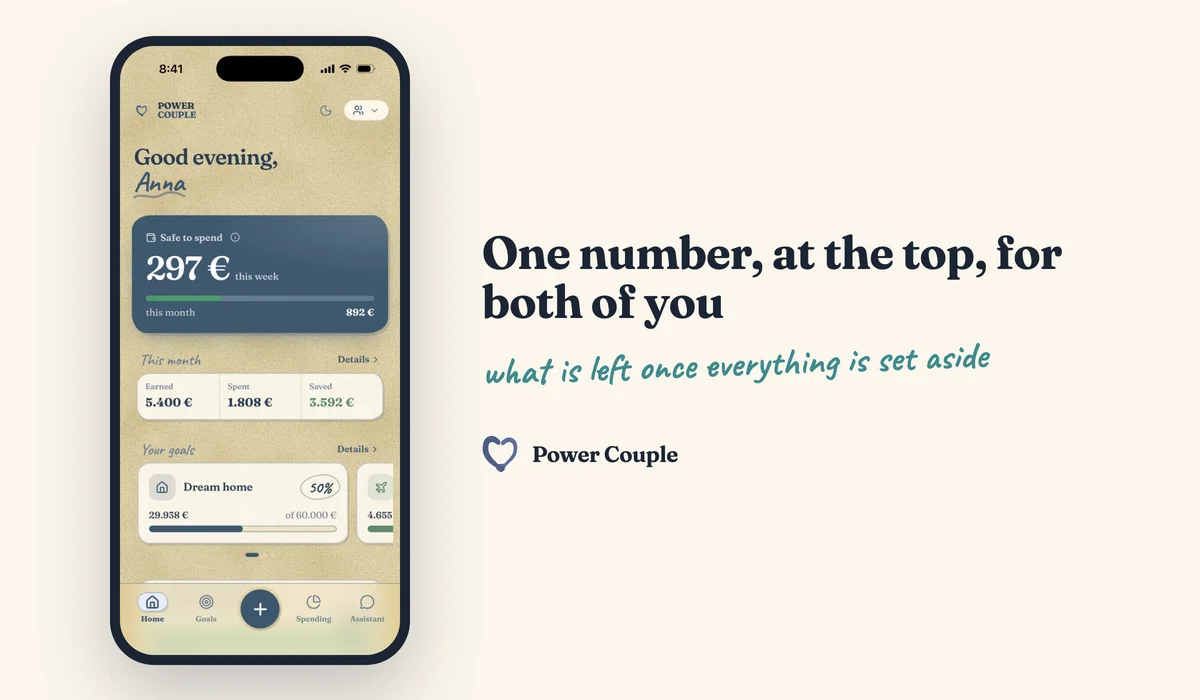
That's what I built Power Couple for. One shared budget both of you open, with entries added from a photo of a receipt, a bank statement file, typing or voice, and no bank login. Safe to spend is the figure it puts at the top, meaning what's left for the rest of the month once bills, goals and both personal allowances are set aside. It's free, and everything is encrypted on the phone, so the numbers stay between the two of you. It also has hidden gifts, which is a purchase your partner can't see until the date you choose.
My view on whose money this is
If you've committed to each other for life, I recommend one shared pot. All income goes in, there's no "his" and "hers", and you work toward the same goals whoever earns more. Splitting costs by a formula is for roommates.
There's evidence behind this. A randomised experiment followed 230 engaged and newly married couples who held separate accounts, assigning some of them to merge their money. Over two years, the couples who merged held their relationship quality steady where the others declined (Olson and colleagues, Journal of Consumer Research, 2023).
December is where the difference shows most. With one pot there's a gift limit. With two there are two limits, plus the question of who paid for the dinner and who's covering the fuel to your parents' house.
One exception I'd never leave out. Where one partner uses money to control the other, keep access to an account in your own name and get help. Pooling assumes trust.
This is general information about handling money together and not personal financial advice.
How this post was put together
I checked every source linked above on 3 November 2026, read for what it actually says rather than what other pages say it says, and dated, so you can see how old each number is. The "average 2026 holiday spending" figures circulating with no survey behind them were left out, and the one survey quoted here is named with its field dates. Our editorial rules are on the about page. If you find something wrong here, contact me and I'll fix it.
Questions people ask
How much should a couple spend on Christmas?
Whatever is left after you've held back January and covered what you already owe. In the example that's $1,050 of a $1,200 pot. The percentage matters less than the order, because what gets set aside first is what survives.
How much should we spend on each other?
Whatever fits in each of your personal allowances, and that's the whole answer. As long as you both have the same amount, the gift stops being a comparison.
What if one of us earns a lot more?
The pot doesn't change and neither does the allowance. Both are equal by agreement, not in proportion to income. If one of you is buying a bigger gift because they earned more, you've started keeping score, and December is a bad month to start.
Should we use buy now, pay later for gifts?
Only if the instalments fit in next year's monthly budget and you looked at them together before agreeing. Four payments spread across January and February compete with January's bills, which is the month the plan was built to protect.
When should we sit down and do this?
Before anything is bought, and ideally before December. After the first shopping trip a plan isn't a plan, it's an explanation.