How to split bills when one partner earns more
The 50/50 and proportional splits in dollars, what each partner has left, and why a couple committed for life shouldn't split at all when incomes differ.

When one partner earns a lot more, a 50/50 split is rarely fair and a proportional split is. Each person pays the same percentage of their income toward shared bills. That's the answer most people are searching for, and the numbers are below. But if you've committed to each other for life, I recommend not splitting anything. All income goes into one pot and each partner gets the same personal money. A big income gap is where that choice matters most.
Key takeaways
- A proportional split is shared bills × your income ÷ combined income. At $4,500 and $1,500 a month, one partner pays three quarters of the bills and the other one quarter.
- With 50/50, the lower earner pays 93% of their income toward shared bills and has $100 left. The higher earner pays 31%.
- Even with a proportional split, one partner keeps $2,400 and the other $800. The formula evens out the bills and leaves the gap where it was.
- Every raise or pay cut means recalculating the percentages. In one pot there's nothing to recalculate.
- For a couple committed for life, I recommend one shared pot with the same personal money for each partner.
How do you split bills when one partner earns more?
There are two usual ways, and they're the two the top search results teach.
50/50. Add up the shared bills and each partner pays half.
Proportional. Each partner pays the same percentage of their income. The formula is shared bills × your income ÷ combined income. Mexico's consumer protection agency lists it as one of three methods for couples, where each person pays a share of the bills equal to their share of household income (Profeco, 17 February 2022, in Spanish).
A YouGov survey of 1,254 Britons who live with a partner and both work found that when one partner earns a lot or a moderate amount more, 49% split proportionally. Even so, among couples where one earns "a lot" more, 25% still split essential spending 50/50 (YouGov, 29 August 2024).
One month of bills, both ways
Emma earns $4,500 a month and Jake earns $1,500. Together that's $6,000. Their shared bills come to $2,800.
| Shared bill | Per month |
|---|---|
| Rent | $1,400 |
| Groceries | $700 |
| Utilities (power, water, gas, internet) | $350 |
| Insurance and phones | $350 |
| Total | $2,800 |
| Method | Emma pays | Jake pays | Emma keeps | Jake keeps |
|---|---|---|---|---|
| 50/50 | $1,400 (31% of her income) | $1,400 (93% of his income) | $3,100 | $100 |
| Proportional (3/4 and 1/4) | $2,100 (47%) | $700 (47%) | $2,400 | $800 |
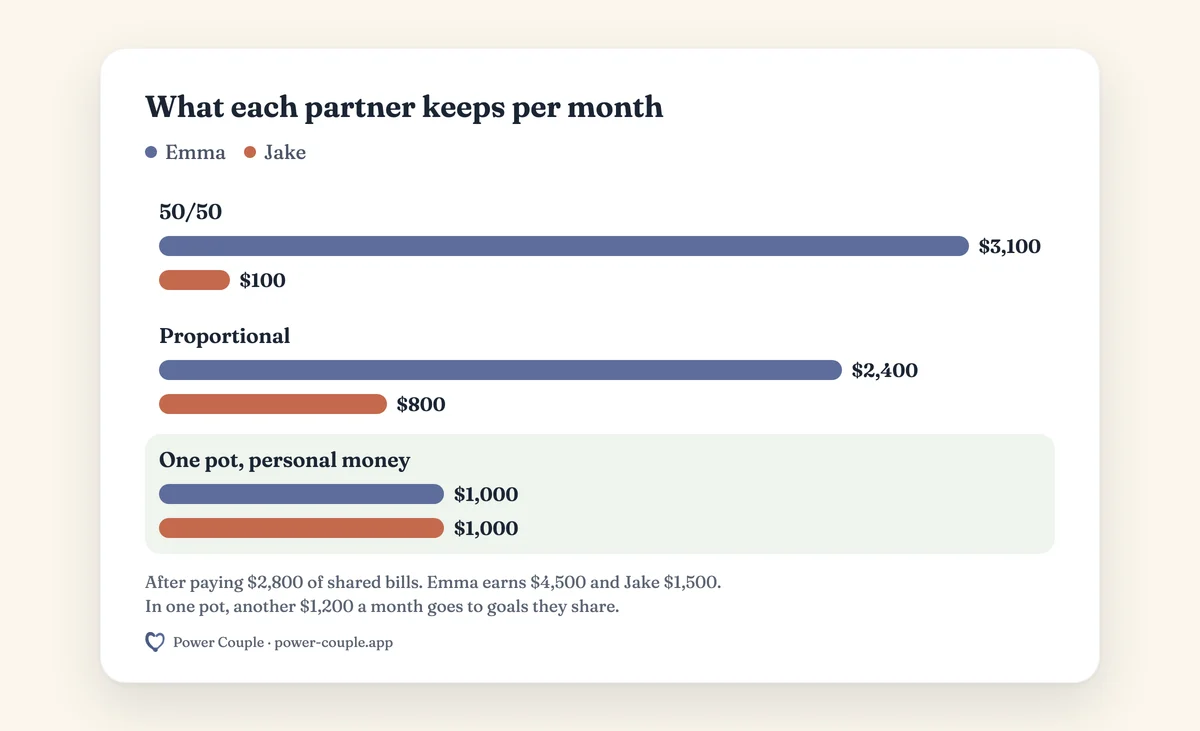
With 50/50, Jake has $100 for the whole month, savings included. That isn't fair between two people who earn differently. With the proportional split both pay 47% of their income, which is why it's the one the guides teach.
Now look at the last column. After paying their "fair" share, Emma has $2,400 left and Jake $800. Three to one. That's the money for saving, going out and buying what they want. The proportional split shares the bills evenly and leaves untouched the difference in what each partner can do with their month.
What happens to the formula at the first raise
Jake gets a raise and now earns $1,800. Combined income goes to $6,300 and the percentages move. Emma now pays 4,500 ÷ 6,300 of the bills, which is $2,000 of the $2,800, and Jake pays $800. Jake's pay went up $300 and his share of the bills went up $100, from $700 to $800. Emma's dropped from $2,100 to $2,000. The next time Emma gets overtime or a bonus, they redo the math.
Every income change opens a small negotiation, and that's the part the guides skip. You have to agree whether to use income before or after tax, whether bonuses count, and whether one-off money counts. Profeco says there is no ideal method for splitting expenses as a couple, and it names the higher earner's possible resentment as the risk of the proportional method (Profeco, 2022).
The same month in one pot
If you've committed to each other for life, do something else. Both incomes go in together. The $2,800 of shared bills comes out first. You agree how much to save for your goals, say $1,200. What's left is split equally as personal money.
| One shared pot | Per month |
|---|---|
| Combined income | $6,000 |
| Shared bills | $2,800 |
| Savings for goals you share | $1,200 |
| Emma's personal money | $1,000 |
| Jake's personal money | $1,000 |
The $6,000 isn't divided into "Emma's" and "Jake's". Each has $1,000 to spend without explaining. When Jake gets his raise, $300 more goes into the pot and they decide together what to do with it. There are no percentages to recalculate.
Mexico's financial consumer agency, CONDUSEF, recommends that each partner have a "personal fund" (CONDUSEF, "Amor que sí cuenta", February 2026, in Spanish). In one pot, that personal money comes out of the pot, it's equal for both, and it doesn't depend on who earned more.
Why I recommend not splitting
My partner and I are preparing to get married, and we sometimes disagree about money decisions. Here's what I believe. When two people commit to each other for life, the money belongs to both. A proportional split is a good formula for two people sharing an apartment. For two people sharing a life, it keeps an open tab of who earned what and who paid for what.
With a big income gap, that tab shows every month. The higher earner sees their number in the table, and the lower earner sees theirs. One pot closes it. What matters is the plan you make together, not who put in more. That takes trust. You both see every number, and nobody uses the shared money against the other.
The best evidence is a randomized experiment published in the Journal of Consumer Research in 2023. It followed 230 engaged or newly married couples in the United States. Couples were randomly asked to merge their money into a joint account, to keep it separate, or to choose for themselves. Over two years, the couples who merged kept their relationship quality, and the others showed the usual decline. Merging only part of the money wasn't linked to the same benefit (Kellogg Insight, May 2023; the paper, DOI 10.1093/jcr/ucad020).
If one partner uses money to control the other, the partner on the receiving end should keep an account in their own name and get help. One pot works on trust.
How to move from splitting to one pot
- Put both incomes and all shared bills on the table. Every number, no exceptions.
- Decide how much you save for your goals.
- Set the same personal money for each partner, and an amount above which you tell each other before spending.
- Choose where the money lives. One joint account, or separate accounts you treat as one pot.
- Review the month together, once a month and whenever an income changes.
Power Couple is built for this. One encrypted budget for both incomes, no split percentages, personal money for each partner and no bank login. The five ways couples can organize money, side by side, are in the post on how to split finances as a couple.

Frequently asked questions
Is it fair to split bills 50/50 if one partner earns more?
Between roommates, it's an option. For a couple committed for life, I wouldn't split anything. With the example numbers, 50/50 leaves the lower earner $100 and the higher earner $3,100.
How do you calculate each partner's percentage?
Divide each person's income by your combined income. With $4,500 and $1,500 that's 75% and 25%. Multiply that percentage by the shared bills. It's simplest if you both use the same kind of income, before or after tax.
What if the higher earner feels resentful?
Profeco lists it as the risk of the proportional method (2022). The resentment comes from keeping score of who contributes what. One pot takes that out of the relationship, because nobody pays "their share". Both incomes belong to the household.
Should personal money be equal for both partners?
For me, yes. Equal and agreed by both, whoever earns more. It's how nobody has to ask permission to buy a coffee.
How often should we review the percentages?
In one pot there are no percentages. Review the plan once a month and when something big changes, like a new job, a raise, a move or a baby.