Joint vs separate bank accounts: what changes, and what I recommend
Joint or separate bank accounts? What a joint account changes in law and deposit insurance, and why committed couples should run all money as one pot.
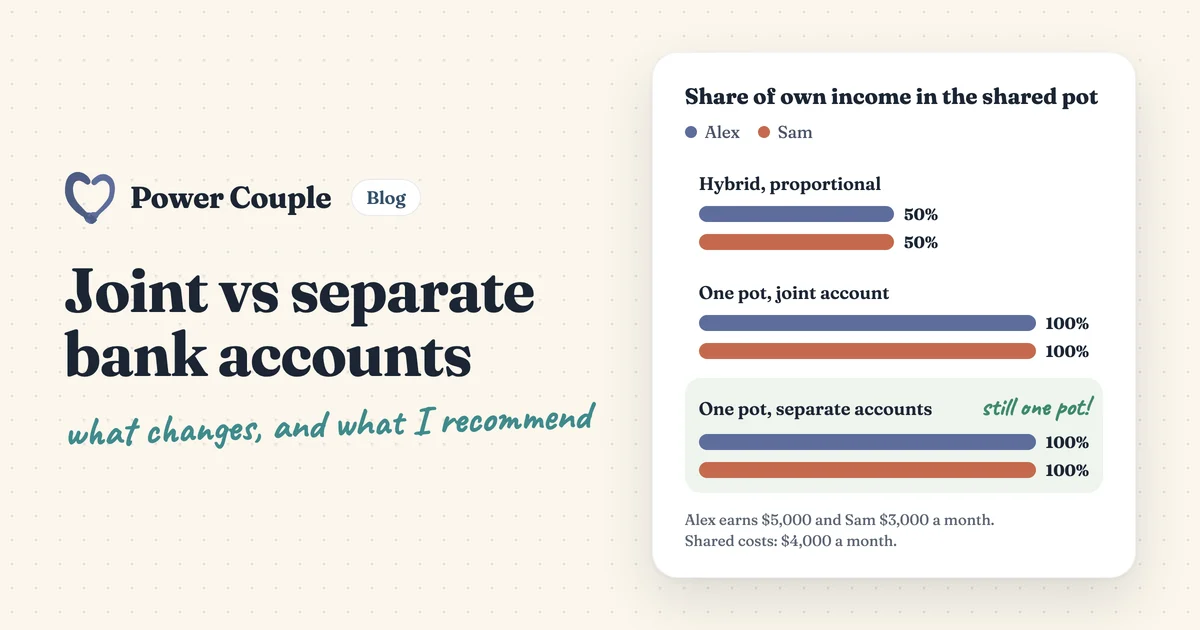
A joint bank account changes three things. Either of you can usually spend or withdraw all of the money, deposit insurance counts each owner separately, and the money stays reachable if one of you dies or can't act. What it doesn't decide is whose money it is. For a couple who've committed to each other for life, my answer is simple. All of it belongs to both of you, so run it as one shared pot. A joint account is the easiest way to do that. Separate accounts work too, as long as you both see every number and plan together.
Key Takeaways
- Where your money sits and whose it is are two different decisions. For a couple committed for life, I recommend one shared pot, joint account or not.
- In most cases either owner of a joint checking account can withdraw the money and close the account, according to the CFPB.
- FDIC insurance covers each co-owner of joint accounts up to $250,000 per bank, so a couple's joint account can be insured up to $500,000.
- The name on an account doesn't decide who owns the money. In the nine community property states, income earned during the marriage generally belongs to both spouses.
What's the difference between joint and separate bank accounts?
A joint account has two or more owners with equal rights to all the money in it; a separate account has one. Most couples end up with one of three setups:
| Setup | How it works | Typical reason |
|---|---|---|
| All joint | Both incomes land in one or more shared accounts, and all spending comes out of them | Simplicity, full pooling, often longer marriages |
| All separate | Each keeps their own accounts and pays an agreed share of the bills | Independence, second marriages, unmarried couples |
| Hybrid ("yours, mine and ours") | A joint account for shared bills and goals, plus a separate account each | Shared costs paid in one place, the rest kept apart |
These setups only describe where the money sits. A couple can hold everything jointly and still keep score, or keep separate accounts and treat every dollar as shared.
In the US, 77% of married couples with bank accounts had at least one joint account in 2023, and 40% held every account jointly. Both shares have fallen since 1996, when 53% held everything jointly. Couples who've been married longer share more, 79% of those married 9 to 13 years had a joint account, against 68% of those married 4 to 8 years. Among unmarried couples living together, only 16% had one (US Census Bureau, Sep 2025).
What a joint account changes
Either of you can take all the money
The Consumer Financial Protection Bureau puts it plainly. "In most circumstances, either person on a joint checking account can withdraw money from and close the account" (CFPB, Ask CFPB, reviewed 18 Dec 2024). For a couple who share everything, that's the point. It's also why trust comes first.
Deposit insurance counts each owner
The FDIC insures each co-owner's share of all joint accounts at the same bank up to $250,000, and it assumes each owner owns an equal share unless the bank's records say otherwise (FDIC, "Joint Accounts", updated 29 May 2024). If you're saving a big home deposit, a joint account at one bank can be insured up to $500,000.
The money stays reachable if one of you can't act
With a joint account, either of you can keep paying the rent if the other is in hospital, out of reach, or dies. With separate accounts, the other partner may need a power of attorney, or after a death may have to wait until the estate is settled.
Does a separate account keep your money separate?
Not necessarily. The name on the account decides who the bank lets withdraw the money. Who owns it is decided by your relationship status and the law where you live.
Nine US states are community property states. Arizona, California, Idaho, Louisiana, Nevada, New Mexico, Texas, Washington and Wisconsin (IRS Publication 555, revised Dec 2024). Community property means that income earned during the marriage generally belongs to both spouses, even when it's paid into an account in one name. (This is general information, not legal advice.)
Do couples with joint accounts get along better?
One well-designed study says yes. In a 2023 field experiment, Jenny Olson and colleagues randomly assigned 230 engaged or newly married US couples to merge their money into a joint account, keep it separate, or choose for themselves. Over two years, the couples told to merge kept their relationship quality, while the other two groups showed the usual decline (Kellogg Insight, 9 May 2023, summarizing Olson et al., Journal of Consumer Research, 2023).
The researchers' explanation is that pooled money pushes couples toward shared goals. If all money is everyone's money, nobody needs to keep score. Partly merging, with a joint account next to separate ones, wasn't associated with the same benefit. That matches my view. Half a pot still keeps score.
Running one pot across separate accounts
What makes money one pot is how you run it:
- Both incomes count as the household's, whoever earns more and whichever account they land in.
- Every income and every cost goes into one budget you can both read.
- You plan the pot together. Shared costs, savings for your goals, and the same personal allowance for each of you.
- You review it together on a fixed rhythm.
Take Alex and Sam. Alex's monthly income is $5,000 and Sam's is $3,000. Their shared costs are $4,000 a month, each gets a $1,200 personal allowance, and $1,600 goes to savings for shared goals.
| One pot in a joint account | One pot in separate accounts | |
|---|---|---|
| Where the income lands | Both incomes, $8,000, in the joint account | $5,000 in Alex's account, $3,000 in Sam's |
| Shared costs ($4,000) | Paid from the joint account | Alex's account pays rent and utilities ($2,600); Sam's pays groceries, insurance and phones ($1,400) |
| Personal allowance | $1,200 each | $1,200 each |
| Shared goals | $1,600 saved from the joint account | $1,600 saved, $1,200 from Alex's account, $400 from Sam's |
| How both see everything | The joint statement, plus a shared budget | One shared budget with both accounts in it |
| What it asks of you | Trust, because either of you can spend from it | One shared record, or it slides back into "mine" and "yours" |
My fiancée and I are both planning to keep everything in one pot. Whatever she earns is mine, and whatever I earn is hers. In other words, all of our efforts are fruits that we both enjoy.
That's exactly why we need to set clear expectations on the goals we're working toward and stay accountable for our choices. But it's very important not to make it unpleasant. My fiancée has already suggested that we have a business-like discussion every four to six months to check how we're doing with our goals. Of course, that's on top of our weekly review of our finances. We both believe that's how we can become a powerful couple achieving great things.
Power Couple is built for exactly this. One shared, encrypted budget for both incomes, with no split ratios, a personal allowance for each partner, and no bank login, so it works with whatever accounts you have (see how it works).

What I recommend for your situation
| Your situation | What I recommend | Why |
|---|---|---|
| Married, or committed for life | One shared pot, ideally in a joint account | All the money is both of yours, and either of you can act in an emergency. |
| Committed for life, with a large income gap | One shared pot | The gap stops mattering when all income is the household's. |
| Committed for life, but your accounts stay separate for now (an old account, an employer's payroll bank) | One pot across your accounts, with one shared budget | Where the money sits matters less than both of you treating it as "ours". |
| Living together, not committed for life yet | Separate accounts, sharing the costs | Merging belongs with the commitment. |
| One of you brings debt | One pot, with the repayment in your shared plan | A debt you both know about is part of the plan. A hidden one breaks trust. |
| Worried about financial control | Keep an account in your own name and get help | One pot runs on trust, and access to your own money is a safety net. |
Frequently asked questions
Can my partner withdraw all the money from our joint account?
Usually, yes. The CFPB says either person on a joint checking account can generally withdraw the money and close the account. In a couple that shares everything, that's how it should work.
Is a joint account insured for more than a single account?
Yes, at FDIC insured banks. Each co-owner's share of joint accounts at the same bank is insured up to $250,000, so a two-person joint account can be covered up to $500,000.
What percentage of married couples have joint accounts?
In 2023, 77% of US married couples with bank assets had at least one joint account, 40% held all accounts jointly and 23% had none, according to the US Census Bureau's 2025 analysis of SIPP data.
Do we need a joint account to share everything?
No. A joint account is the easiest way to run one pot, but separate accounts work too if you treat all income as shared and keep one budget you both see.
Should we open a joint account before we get married?
My line is a lifelong commitment rather than the wedding date. Until you've made it, keep separate accounts and share the costs; only 16% of unmarried US couples living together had a joint account in 2023. Once you have, go for one pot, and a joint account is the easiest way to run it.